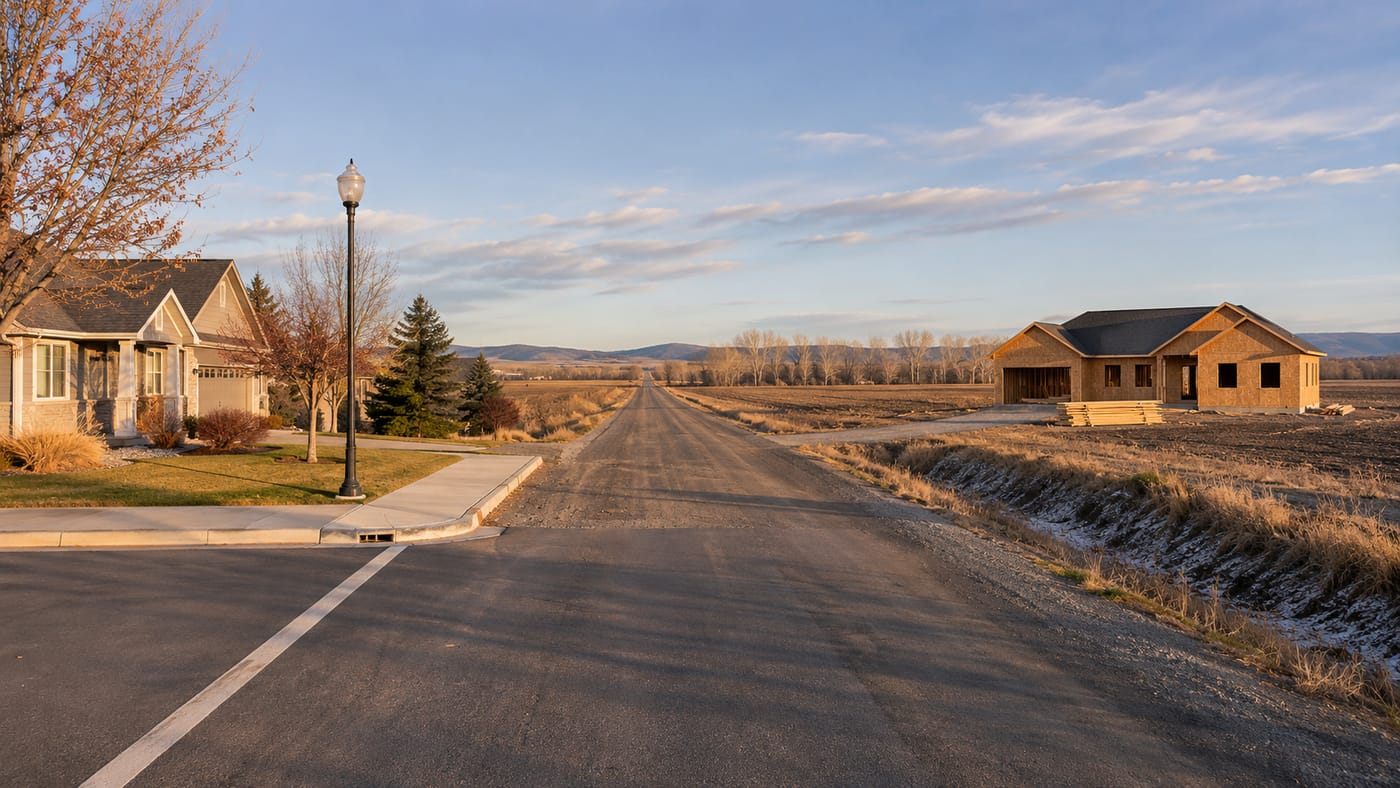
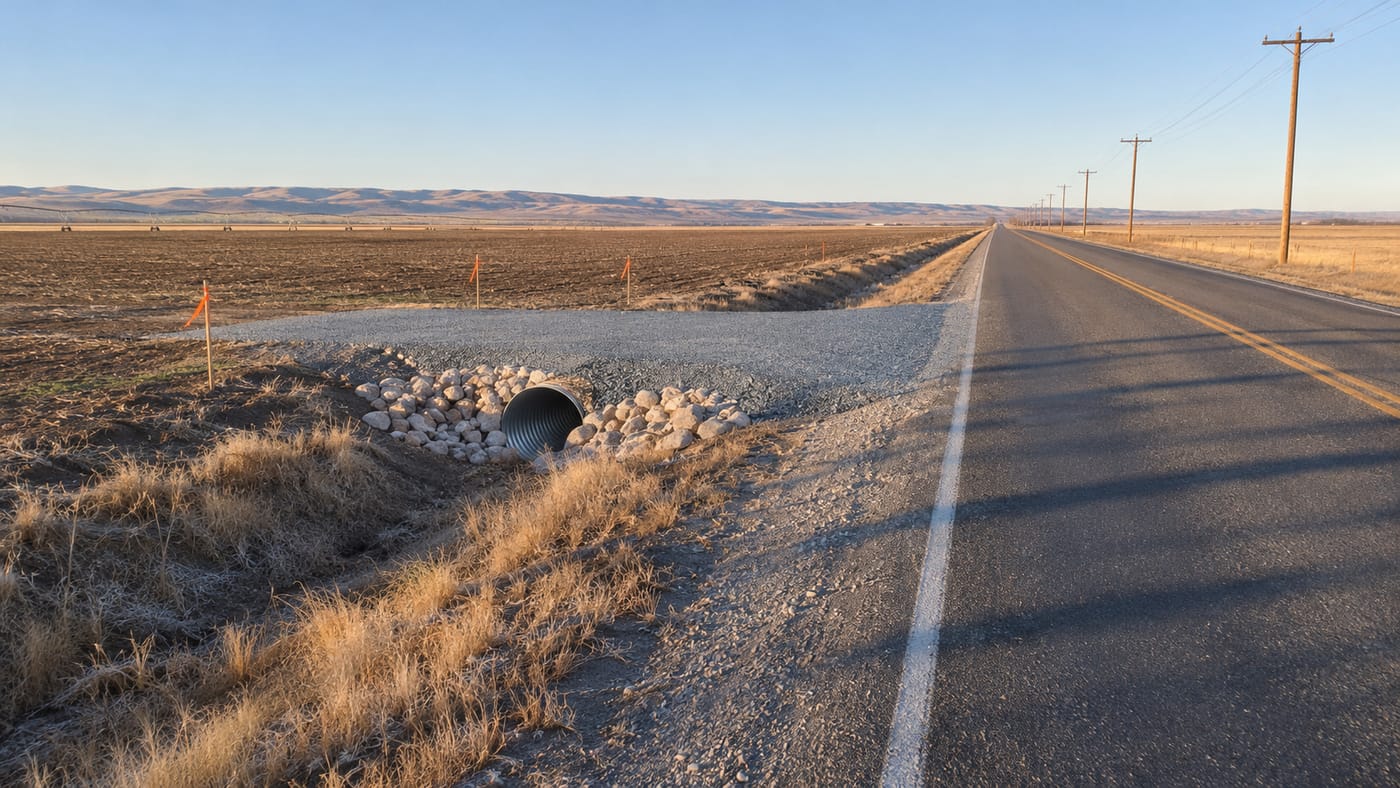
A parcel that touches a road is not the same as a parcel you can build a driveway onto.
Getting permission to connect to that road is its own permit, from its own agency, and on a rural parcel it is one of the few items that can stop a project outright. Here is who you are dealing with and what they can say no to.
There is not one road authority. There are six.
This is the part that catches people, and it is the same shape as the City versus County confusion we wrote about separately.
Twin Falls County's current building submittal checklist, revised May 2024, requires Highway District Approval or Comment before it will accept a residential building permit application. Then it lists which districts you might need it from:
- Buhl Highway District
- Filer Highway District
- Murtaugh Highway District
- Twin Falls Highway District
- Idaho Transportation Department, for state highways
Plus the City of Twin Falls, if your parcel is inside city limits.
Four separate highway districts in one county. Each has its own boundaries, its own staff, and its own process. Which one you deal with is a function of where your dirt is, and it is not something to assume from the mailing address.
The same checklist requires three other outside approvals alongside it: South Central Public Health approval with a stamped site plan, canal company approval or comment, and fire district approval or comment. Your building permit application is not complete until all four agencies have weighed in.
State highways are the strict ones
If your frontage is US 93, US 30, or a state route, you are dealing with the Idaho Transportation Department, and ITD's right-of-way rules are considerably more involved than most people expect.
You need a permit, and you cannot work first. Anyone planning to change an approach must obtain a permit to use state highway right-of-way, and work in the right-of-way is barred until it is issued.
Only the owner can apply. Access applications come from an owner of property abutting the right-of-way, or a designated representative with notarized written authorization. Your builder cannot simply apply on your behalf without that.
Spacing can be the dealbreaker. The rules do not cap how many approaches a parcel may have. Instead they set minimum spacing between accesses, and on a rural statewide route unsignalized accesses must be at least 650 feet apart.
Read that against a narrow parcel. If your frontage cannot achieve the spacing, you do not get your own approach where you want it. The rules provide for joint-use approaches where a property's frontage is too narrow for the full approach width including both radii, which means sharing a driveway entrance with a neighbor.
Sight lines are enforced. Any obstruction constituting a traffic hazard within the vision triangle has to be removed. That triangle extends 40 feet in each direction from the intersection and runs from 3 to 10 feet above the centerline elevation.
They can say no. The District Engineer may deny a permit, or require a Traffic Impact Study, if an on-site review shows sight distance or queue conditions fall short of what the spacing tables assume.
And an unpermitted approach is not a fait accompli. Approaches installed without a permit, or not built to permit requirements, may be removed or their use suspended. A permittee given notice to upgrade a nonstandard encroachment has one month to comply before the permit is revoked and the encroachment removed. The applicant pays for changes to highway features, the state makes no reimbursement for removing unauthorized encroachments, and permit fees are not refunded if the application is denied.
Approach categories, for what it is worth, are specific: single residential, multiple residential, farmyard and field, commercial, boulevard, joint-use, and public highway. A field approach is not a residential approach, which matters if you are building a house where a farm entrance already exists.
Inside the city, it is a Right of Way Permit
Different process, different name, different desk.
The City of Twin Falls Right of Way Permit covers driveways and approaches along with utilities, sidewalks, curb and gutter, trenching, and road closures. A few specifics worth knowing:
- Applications go to rowpermit@tfid.org, and you are asked to allow three business days for review.
- The contractor may not begin work until the permit is approved.
- A site plan, construction plans with typical sections, and, where lanes are restricted, a traffic control plan are all required.
- Fees run $75 flat for up to 300 linear feet, then $0.25 per linear foot beyond that.
- Arterial roads are a different tier: a $300 non-refundable processing fee plus a cash bond equal to 300 percent of the engineer's estimate, refundable on acceptance.
- There is a $15 per day expiration penalty.
- Inspections are called to (208) 735-3446 with 24 hours notice, and lane closures require 48 hours notice.
If your lot fronts an arterial, that bond requirement is a real cash flow item that nobody budgets for.
Where this sits in your permit sequence
This is not a detail you handle later.
The City's residential new home submittal list requires a Highway District approach permit and a canal company approval letter for parcels outside a platted subdivision, as part of the package submitted with the application. The County requires Highway District approval or comment the same way.
In other words, the approach approval has to exist before your building permit application is accepted. It is upstream of the permit, not downstream of it, and the agency issuing it has its own queue.
What this means if you are shopping for land
Three things, in order of how badly they can hurt.
Confirm which authority controls the road. Not the county generally, the specific highway district, or ITD, or the city. The county's checklist names them, and ITD publishes general highway maps for the county showing local road networks.
Confirm an approach can be permitted where you need one. On a state highway that means spacing and sight distance. On a county road it means asking the district. A parcel with one buildable approach location that fails sight distance is a parcel with an access problem, and no amount of design solves it.
Check whether an existing approach is actually permitted and of the right type. A field entrance that has been there for forty years is not automatically a permitted residential approach, and ITD's rules distinguish between the two.
We put approach access first on the list in the post about what to check before buying land, and this is why.
One honest note
We were not able to retrieve the Twin Falls Highway District's own website while writing this, so nothing here describes that district's specific forms, fees, or process. The structural facts above come from the county's checklist, ITD's rules, and the City's application.
Call the district that covers your parcel directly, and get your requirements from them rather than from any article, including this one.
What to ask
- Which authority controls the road my parcel fronts?
- Can an approach be permitted where I need the driveway, and has anyone looked at sight distance?
- Is there an existing approach, is it permitted, and is it the right category?
- If it is a state highway, does my frontage meet the spacing requirement, or am I looking at joint use?
- Who applies, and does the application need to come from me as the owner?
- If I am in the city on an arterial, what is the bond?
- How long does the approach approval take, and does it hold up my building permit?
Question seven is the schedule question. The approach approval is upstream of your building permit, so its timeline is your timeline.
Building on a rural parcel in the Magic Valley?
We build custom homes, additions, ADUs, shops, remodels, and barndominiums across Twin Falls, Jerome, Kimberly, Buhl, Filer, Burley, Rupert, and unincorporated Twin Falls County.
We will find out which highway district or agency controls your frontage, start the approach conversation early enough that it does not hold up your permit, and tell you honestly if a parcel has an access problem that design cannot fix.
We are a registered Idaho contractor, RCE-65510, insured and warrantied.
Tell us about your project → or call (208) 731-1729
Requirements, fees and procedures above are published by Twin Falls County, the City of Twin Falls, and the Idaho Transportation Department, and are current as of this writing. The ITD document cited is that agency's published rule manual; confirm current rules with ITD. Highway district requirements come from the district covering your parcel. All of these change, so verify before relying on any of it.
Frequently asked questions
What is an approach permit? Permission to connect a driveway to a public road. It is a separate permit from your building permit, issued by whichever agency controls that road.
Who do I get it from in Twin Falls County? It depends on the road. The county's submittal checklist names the Buhl, Filer, Murtaugh, and Twin Falls Highway Districts, plus the Idaho Transportation Department for state highways. Inside city limits it is the City.
Do I need it before my building permit? Yes. Both the City's residential submittal list and the County's checklist require highway district approval as part of the application package, so it has to exist before the application is accepted.
Can they refuse to let me build a driveway? On a state highway, yes. ITD's rules allow the District Engineer to deny a permit or require a Traffic Impact Study where sight distance or queueing falls short, and set minimum spacing between accesses, at least 650 feet apart on a rural statewide route.
What is a joint-use approach? A shared driveway entrance. ITD's rules require one where a property's frontage is too narrow to fit the full approach width including both radii.
There is already a driveway on the property. Am I fine? Not necessarily. Verify it is permitted and that it is the right category. A farmyard or field approach is a different classification from a residential approach.
What does an approach permit cost in the city? The City's Right of Way Permit is $75 flat up to 300 linear feet and $0.25 per linear foot beyond. Arterial roads add a $300 non-refundable processing fee and a cash bond equal to 300 percent of the engineer's estimate.
What if someone built an approach without a permit? ITD's rules allow unpermitted or non-conforming approaches to be removed or their use suspended, with no reimbursement, and the cost falls on the applicant.