TL;DR
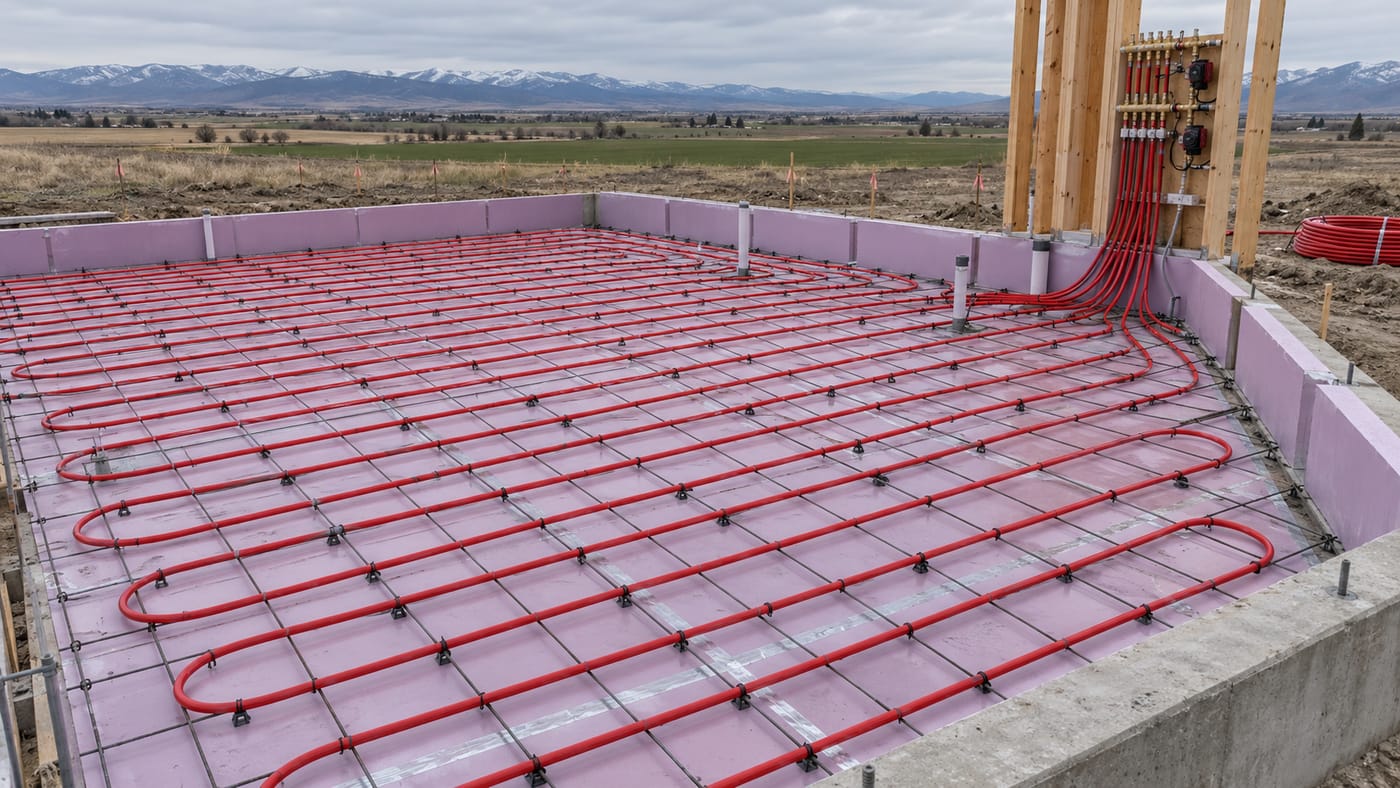
- Radiant floor heat is a slab decision, not a mechanical decision. The tubing goes in before the concrete is poured, which means you decide during design or you do not do it at all.
- The tubing is the cheap part. The boiler or heat source, manifolds, zone controls, and the insulation the code requires underneath are where the money is.
- A heated slab triggers more insulation than an unheated one. Under the 2018 IECC, a heated slab requires R-5 under the full slab area on top of the slab edge requirement. That is real concrete money, not a rounding error.
- It does not cool. You will still need a separate system for summer, and if that system is central air, you are installing ductwork anyway, which undercuts the usual "no ducts" selling point.
- It responds slowly. A heated slab is a flywheel, which is wonderful for steady temperatures and bad for setbacks and quick recovery.
- In a well-insulated house you may not get warm floors. If the house barely loses heat, the floor barely has to run, and the surface sits near room temperature. People are often surprised by this after paying for it.
- The strongest case in Idaho is a shop or garage that stays heated through the winter, not one that gets heated only when you are using it.
Here is the honest version, including the parts that argue against it.
What it actually is
Two systems get called radiant floor heat and they are not the same thing.
Hydronic circulates warm water through PEX tubing embedded in or under the floor. A boiler, water heater, or heat pump heats the water, a manifold splits it into loops, and each loop serves a zone. This is the version that makes sense in a whole house.
Electric runs resistance cable or mats under the finish floor. It is simple, it is cheap to install, and it is expensive to run at scale. Electric belongs in a bathroom floor or a small area. It is not a way to heat a house in a 0 degree climate.
For the rest of this post, radiant means hydronic in a concrete slab, because that is the decision people are actually weighing when they are building.
Why this is a slab decision
This is the part that makes it urgent rather than optional.
The tubing is tied to the reinforcing and embedded in the pour. Once the concrete is down, adding it means demolition. There is no retrofit version of in-slab radiant that resembles the original.
So the decision belongs in design, alongside the foundation and the mechanical layout. It needs to be settled before the slab is scheduled, not when you are picking finishes.
That is also why it tends to get decided badly. It comes up early, when the budget still feels abstract, and it gets either waved through on enthusiasm or cut on reflex. Both are guesses.
The cost nobody mentions: the insulation under it
Here is the item that separates a real conversation from a sales pitch.
A heated slab has to be insulated more than an unheated one, because a warm slab sitting on cold ground will push heat straight into the dirt. The energy code accounts for this, and it is not a small adder.
Twin Falls County is in climate zone 5. Pacific Northwest National Laboratory's code comparison puts the 2018 IECC zone 5 slab requirement at R-10 to a depth of 2 feet, and states the heated slab provision this way: "R-5 insulation shall be provided under the full slab area of a heated slab in addition to the required slab edge insulation R-value for slabs."
Read that carefully. Not R-5 added at the edge. R-5 under the entire slab footprint, on top of the edge requirement.
On a 2,400 square foot slab, that is 2,400 square feet of rigid foam you would not otherwise be buying, plus the labor to lay it and the care to keep it intact during the pour. It is one of the larger single line items in the whole radiant decision and it is almost never in the number someone quotes you over the phone.
One important caveat, and we want to be precise about it. Idaho enforces the 2018 IECC with state amendments, effective January 1, 2021, and Idaho's building code rules amend Table R402.1.2 specifically for climate zones 5 and 6. We are quoting the model code baseline above rather than publishing an Idaho-amended figure we cannot verify to the digit. Confirm the exact current requirement with your building department before anyone prices the foam. The direction is not in question. A heated slab needs more insulation than an unheated one, and that cost belongs in the comparison.
What it is genuinely good at
Not a hedge. These are real and they are why people who have it tend to like it.
Even, quiet, draft-free heat. No blower, no air movement, no dust being pushed around, no temperature stratification where the ceiling is warm and your feet are cold. In a room with a vaulted ceiling, that last one matters more than people expect.
No ductwork for heating. Ducts take up space, leak, and need to be inside conditioned space to perform well. A hydronic system does not need any of that to deliver heat.
Easy zoning. Running separate loops to separate areas is straightforward, so a shop, a master suite, and a basement can genuinely be on different temperatures.
Low water temperatures. A slab has so much surface area that it can heat a house with relatively cool water. That matters because it pairs well with heat pumps and condensing equipment, which get more efficient the lower the water temperature they have to produce.
A warm slab is a nice floor to stand on. With caveats, which is the next section.
What it is not good at
This is the part that gets left out.
It does not cool. You cannot run cold water through a slab in the Magic Valley summer without condensation problems. So you need a second system for cooling, and if that system is central air conditioning, you are installing ductwork after all. At that point the "no ducts" advantage is mostly gone and you are paying for two distribution systems. Ductless mini splits are the usual answer, and they are a real cost and a real aesthetic decision.
It responds slowly. A heated slab holds an enormous amount of heat. That is a feature when the weather is steady and a liability when it is not. Night setbacks do not work the way they do with forced air, because the slab takes hours to come back up. If you want to drop the house ten degrees overnight and have it recovered by six in the morning, radiant is the wrong tool.
In a very well insulated house, the floors may not feel warm. This is the one that surprises people most. The floor only has to be as warm as the heat loss demands. As building science practitioners have put it, in a tight, well insulated home the floors end up close to the thermostat setting. If you are buying radiant for the sensation of warm floors under bare feet, and you are also building a tight, well insulated house, those two goals are partly in conflict. You can have one or the other reliably, and the better house makes the warm floor less noticeable.
Floor coverings fight it. Carpet and pad insulate the floor from the room, which is exactly backwards. Thick rugs do the same thing locally. Some wood flooring has restrictions over radiant. Tile and polished concrete are the natural partners, which is a design decision as much as a mechanical one.
Service access is limited. The tubing is in the concrete. Quality tubing in a properly executed pour is reliable, but the manifolds, pumps, valves, and controls are the parts that fail, and those need to be accessible. This is a reason to care about who installs it.
Does it save energy?
Carefully: probably not as much as the marketing suggests, and the honest answer depends on the comparison.
Hydronic radiant is a distribution method, not a heat source. The efficiency mostly belongs to whatever makes the hot water. A high efficiency condensing boiler running low water temperatures is efficient. The same boiler serving a poorly insulated slab over cold dirt is throwing heat into the ground.
The legitimate efficiency arguments are real but modest. No duct losses. Low water temperatures that let the heat source run in its efficient range. Possibly comfort at a slightly lower thermostat setting, because an unheated room with a warm floor feels warmer than the air temperature suggests.
The arguments against are also real. The slab's thermal mass makes setbacks largely unavailable, and setbacks are one of the bigger practical savings levers in a cold climate.
Our position: buy radiant for comfort, not for the energy bill. If someone promises you a specific percentage saving, ask what they are comparing it to and what heat source they assumed. If the answer is vague, the number is decoration.
Where it makes the most sense in Idaho
Three situations where we think it earns its cost.
A shop or outbuilding that stays heated all winter. This is the best case, and it is more common here than whole-house radiant. A shop has a big cold slab, a large volume, and often marginal air sealing. Warming the slab warms the thing you actually touch, it does not blow dust around a woodworking space, and the thermal mass rides out the door opening every time you come and go.
The distinction that matters is whether it stays heated. A shop held at 50 degrees all winter and bumped up when you are working in it suits radiant perfectly. A shop that sits at freezing and gets heated only when you walk in does not, because a slab cannot come up fast enough. For that use, a unit heater is the honest answer and it costs a fraction as much.
A basement. Basement slabs are cold, basements are uncomfortable for exactly that reason, and the floor is where the discomfort lives. If you are finishing a basement, this is the strongest whole-house argument.
A main floor that is already going to be tile or polished concrete. If the finish floor was headed that way for design reasons, radiant removes the main objection to those materials and the floor covering conflict disappears.
Where we would push back: a whole house on a crawl space or framed floor, where the installation is more complicated and the thermal mass advantage is smaller, and any project where the radiant budget would come out of the insulation or window budget. Envelope first. A better envelope makes every heating system work better, and it is the one thing you genuinely cannot retrofit cheaply.
How to decide
- Decide during design. If this comes up after the foundation is scheduled, you have already decided no.
- Price the whole system, including the under slab insulation, the heat source, the manifolds and controls, and whatever you are doing for cooling. Comparing tubing cost to a furnace is not a comparison.
- Be honest about setbacks. If your household runs a programmable schedule with deep setbacks, radiant will fight you.
- Settle the flooring question first. If the plan is carpet through the main living areas, reconsider.
- Decide about cooling at the same time. It is the same decision and it is routinely deferred until it is expensive.
- If the budget is tight, insulate better instead. Every time.
What to ask your builder
- What does the under slab insulation add to the slab cost, as a line item?
- What is the heat source, and what water temperature does it run at?
- What is the plan for cooling, and what does that add?
- How many zones, and where are the manifolds accessible?
- What is the total installed cost compared to a conventional system for this house?
- What flooring is planned, and does it work over a heated slab?
- Who is doing the design and the load calculation, and who warranties it?
Building in the Magic Valley?
We build custom homes, additions, ADUs, shops, and remodels across Twin Falls, Jerome, Kimberly, Buhl, Filer, Burley, Rupert, and unincorporated Twin Falls County.
We are a general contractor, not a mechanical contractor, and we will tell you plainly which this is: a decision we help you make and coordinate, with the system designed and installed by the mechanical trade. What we bring to it is the slab, the schedule, and an honest number. If radiant is not worth it on your project, we will tell you that too, and we will usually suggest spending it on the envelope instead.
We are a registered Idaho contractor, RCE-65510, insured and warrantied.
Tell us about your project → or call (208) 731-1729
Energy code requirements cited here are from the model code baseline and the sources linked above. Idaho enforces the 2018 IECC with state amendments, so confirm the current requirement for your jurisdiction before pricing. System design, load calculations, and installation are the responsibility of the mechanical designer and contractor for your project.
Frequently asked questions
Is radiant floor heat worth it in Idaho? It can be, for comfort rather than for savings, and the best cases here are heated shops, finished basements, and main floors already planned for tile or polished concrete. It is harder to justify on a house with carpet, deep thermostat setbacks, or a tight budget that would otherwise go toward insulation.
Can I add it to an existing slab? Not in any way that resembles the original system. In-slab tubing is embedded in the concrete, so adding it later means demolition. This is a design-phase decision.
Does a heated slab need more insulation? Yes. Under the 2018 IECC, a heated slab requires R-5 under the full slab area in addition to the slab edge requirement for the climate zone. Idaho amends the relevant table, so confirm the exact current figure with your building department, but the added cost is real either way.
Does radiant floor heat cool the house? No. You need a separate cooling system, and if that is central air you will be installing ductwork anyway. Ductless mini splits are the common alternative. Either way, cooling belongs in the same decision and the same budget.
Will my floors feel warm? Not necessarily. The floor only runs as warm as the heat loss requires, so in a tight, well insulated house the surface tends to sit close to room temperature. If warm floors underfoot are the goal, say so early, because it changes the design conversation.
Does it save money on heating? Modestly at best, and the savings belong mostly to the heat source rather than the floor. There are real advantages, including no duct losses and low water temperatures that suit efficient equipment, but there is also the loss of effective thermostat setbacks. Buy it for comfort.
Can I put carpet over it? You can, and you should not want to. Carpet and pad insulate the floor from the room, which works directly against the system. Tile and polished concrete are the natural pairings.
What about electric radiant? Fine for a bathroom floor or a small area. Not a way to heat a house at a 0 degree design temperature, where the operating cost gets painful fast.
Is it good for a shop? It is the best case we see here, with one condition: the shop has to stay heated through the winter. A slab held at a moderate temperature and bumped up for working suits radiant well. A shop heated only when you walk in does not, because the slab cannot respond fast enough. For that, a unit heater costs far less and does the job better.
What should I do if the budget is tight? Insulate better. A stronger envelope improves every heating system you might install, it lowers operating cost permanently, and unlike radiant it is the thing you genuinely cannot add cheaply later.