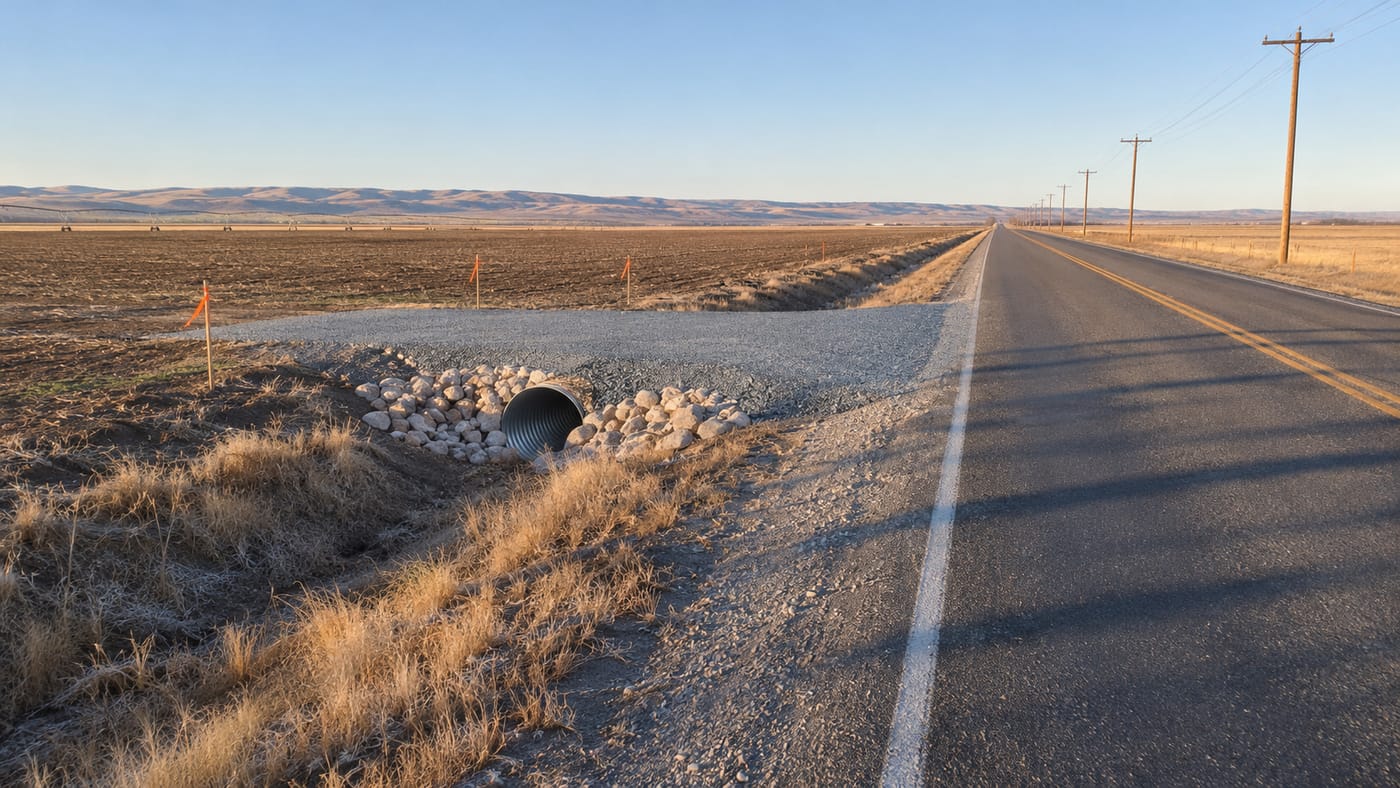
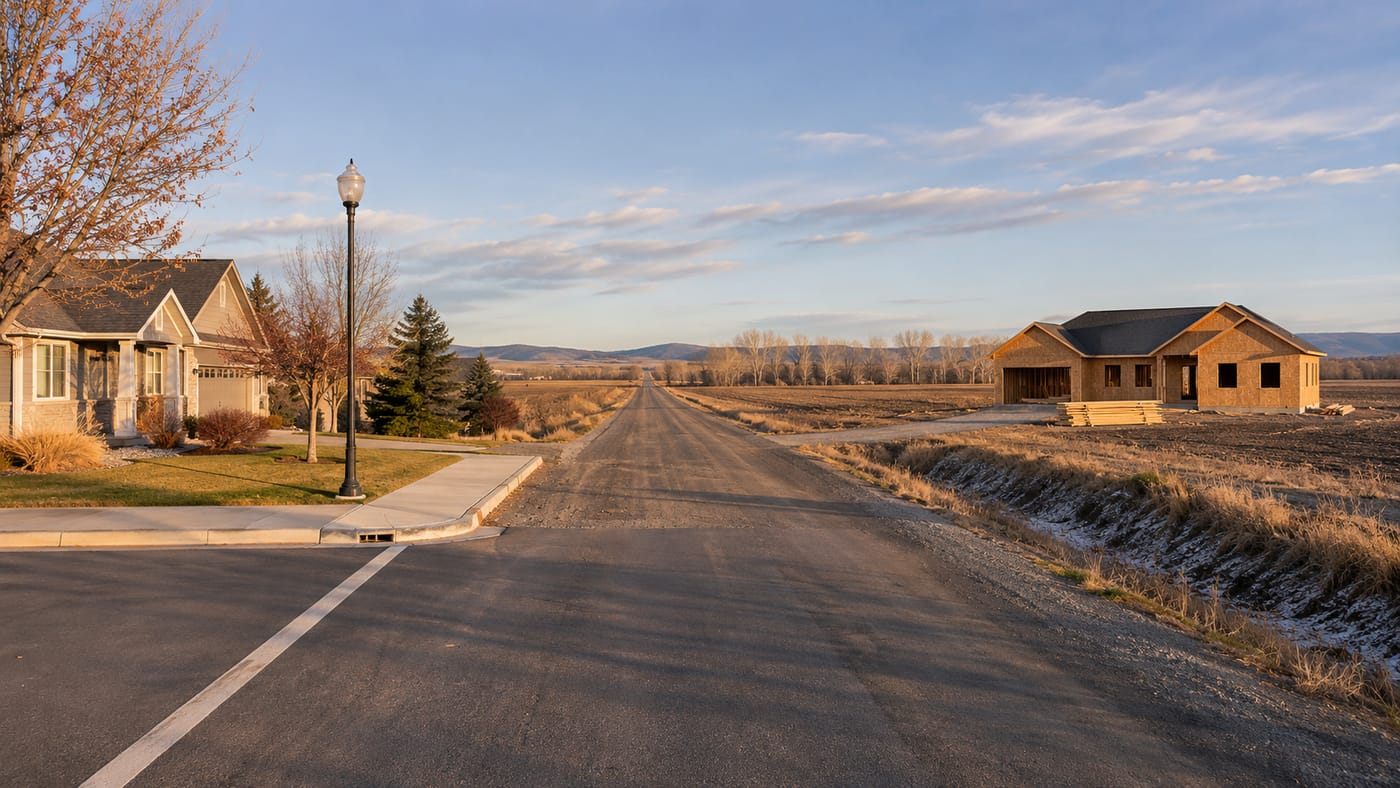
If your parcel is near the edge of town, this is the first question to answer, before design, before engineering, before anybody prices anything.
It is also not a two-way question. There are three answers.
Inside a city, unincorporated county, or an area of impact
Inside city limits, the city issues your permit and inspects your house.
In unincorporated Twin Falls County, the county issues your permit, and the State of Idaho handles your trade inspections.
And then there is the third one. Idaho cities and counties jointly map an area of city impact, the unincorporated land a city expects to grow into. Twin Falls County's zoning code defines it as "land surrounding a city where the city is anticipated to grow in the future," with the boundary agreed between city and county under Idaho Code 67-6526.
Land in an area of impact is still in the county. But under the statute, the governing ordinance has to specify which rules apply there: the city's plan and ordinances, the county's, or a mutually agreed set. The county administers and enforces until the land is annexed.
Twin Falls County's code adds a practical wrinkle. Land use applications in an area of impact get referred to the applicable city, which may submit a recommendation citing its comprehensive plan, but "any recommendation from a city shall not be binding or controlling on the County."
So in an impact area the city has a voice and the county has the decision. If you are out there, you need to know which ordinances were adopted for your specific area, and that is a question for the county's Community Development Services, not a guess.
The phone book is completely different
Not one number is shared between the two jurisdictions.
City of Twin Falls
Inspection | Number |
|---|---|
Building inspection | (208) 735-7333 |
Building department office | (208) 735-7238 |
Plumbing | (208) 735-7299 |
Mechanical | (208) 735-7289 |
Electrical | (208) 735-7235 |
Engineering | (208) 735-3446 |
Fire department | (208) 735-7338 |
Planning and zoning | (208) 735-7267 |
Unincorporated Twin Falls County
Inspection | Number |
|---|---|
Building inspection | (208) 735-4429 |
Mechanical inspection | (208) 735-4432 |
Look at the shape of those two lists. That difference is not cosmetic.
Who inspects your trades, and why it matters
This is the real structural difference between building inside and outside the city.
Inside the City, the City has its own plumbing, mechanical, and electrical inspectors. One jurisdiction, one process, all the numbers above.
Outside city limits, the State does it. Twin Falls County requires that before the framing inspection, and again before the final, all rough-ins for plumbing, electrical, gas, mechanical, fireplace, and firewall or sprinkler systems be completed and signed off by the State of Idaho on the construction card.
That means two governments have to coordinate on one piece of cardboard before your house can proceed past framing.
The Division of Occupational and Professional Licenses runs that side. DOPL issues electrical permits and performs inspections, and it notes that the legislature has authorized some cities and counties to assume jurisdiction within their own boundaries, so "permit requirements vary widely throughout the state." It also warns that a local building permit does not necessarily replace a DOPL permit: "it may still be necessary for you to obtain permits from DOPL for electrical work."
And here is the scheduling detail nobody plans around. DOPL publishes an inspector list with schedules assigning a named state inspector by city and ZIP code, with the days each one inspects. Twin Falls gets electrical and HVAC inspectors five days a week. Smaller towns in the county do not. Some get two days. Different towns in the same county have different inspectors for the same trade.
We are not reprinting names and cell numbers here, because that list is updated and yours should come from the current version. The point is the pattern: if you are building in a smaller town, your trade inspections may only be available on certain days of the week, and that constrains your schedule in a way a Twin Falls build does not.
Scheduling and fees
Both jurisdictions use a 7:00 AM cutoff, and that is roughly where the similarity ends.
City of Twin Falls. Requests through the portal by 7:00 AM are same day. Calls after midnight go to the next business day. Inspections run 8:00 AM to 4:00 PM. Concrete inspections have AM and PM windows, with the AM window requiring readiness by 8:00 and the PM window by noon, and property lines marked with string.
Twin Falls County. Requests after 7:00 AM are scheduled for the next working day. Inspections run roughly 9:30 AM to 4:00 PM. Work is taken in the order received, except footing and foundation inspections, which are prioritized.
On fees, the City publishes two the County does not: a $50 re-inspection fee, charged only when an inspection fails more than once for the same issue and payable before rescheduling, and a $1,000 refundable fee for a temporary Certificate of Occupancy covering certain incomplete work under extenuating circumstances.
The City also states that no occupancy is allowed until the Certificate of Occupancy is issued, that applications expire 180 days after receipt, and that permits expire 180 days after issuance or after the last inspection.
And the design criteria differ too
Worth knowing, because a plan drawn to one set of numbers is not automatically approvable under the other.
Ground snow load, wind exposure category, seismic design category, and winter design temperature all change at the city limit here. We laid out the full comparison, and what each number actually means, in a separate post.
Frost depth and presumed soil bearing are the same in both. Nearly everything else is not.
How to find out which one you are in
Call before you draw anything.
- City of Twin Falls Building Safety Department: (208) 735-7238. The City says anyone unsure whether work needs a permit should call before construction starts, and offers consultation inspections to all customers, including homeowners.
- Twin Falls County Community Development Services for parcels outside city limits, and specifically to ask whether your parcel sits inside an area of city impact and which ordinances were adopted for it.
Both calls are free and both take a few minutes. The cost of guessing is a plan drawn to the wrong criteria.
What to ask
- Is my parcel inside city limits, in unincorporated county, or in an area of city impact?
- If it is an impact area, whose plan and ordinances apply there?
- Who inspects my trades, the jurisdiction or the State?
- If the State does, what days is the inspector available in my town?
- What design criteria apply to my parcel?
- Who is pulling and tracking the permits, and who is chasing the sign-offs?
Question four is the one that quietly decides your schedule if you are building in a smaller town.
Building in the Magic Valley?
We build custom homes, additions, ADUs, shops, and remodels across Twin Falls, Jerome, Kimberly, Buhl, Filer, Burley, Rupert, and unincorporated Twin Falls County.
We work in both jurisdictions and in the impact areas in between. We will tell you which one your parcel falls in, what that changes about your plans and your schedule, and who has to sign what before your house can move past framing.
We are a registered Idaho contractor, RCE-65510, insured and warrantied.
Tell us about your project → or call (208) 731-1729
Phone numbers, fees, scheduling cutoffs and procedures above are published by the City of Twin Falls, Twin Falls County, and the Idaho Division of Occupational and Professional Licenses, and are current as of this writing. All of them change. Confirm with the department issuing your permit, and obtain the current DOPL inspector list rather than relying on any copy of it.
Frequently asked questions
How do I know if my property is in the city or the county? Call the jurisdiction. City of Twin Falls Building Safety is (208) 735-7238, and Twin Falls County Community Development Services handles parcels outside city limits. Do this before design, not after.
What is an area of city impact? Unincorporated land a city expects to eventually annex, mapped jointly by the city and county under Idaho Code 67-6526. The county still administers it, but the governing ordinance determines whether city or county plans and ordinances apply there.
If I am in an impact area, does the city control my project? No. Twin Falls County's code provides that land use applications in an impact area are referred to the city, which may make a recommendation, but that recommendation "shall not be binding or controlling on the County."
Who inspects electrical work outside city limits? The State. DOPL issues electrical permits and performs inspections where it has jurisdiction, and the County requires State sign-off on the construction card before the framing and final inspections.
Does a county building permit cover my electrical work? Not necessarily. DOPL states that a local building permit does not necessarily replace a DOPL permit and that you may still need one for electrical work.
Why does my trade inspection take longer in a small town? DOPL assigns inspectors by city and ZIP code with set schedules. Twin Falls gets most trades five days a week. Smaller towns in the county may get two.
Do the two jurisdictions share phone numbers? None. The City publishes separate numbers for building, plumbing, mechanical, electrical, engineering, fire, and planning. The County publishes two.
Are the building codes the same? The codes are, largely. The design criteria are not. Snow load, wind exposure, seismic category, and winter design temperature all differ between the City and the County.