TL;DR
- Septic and water come before design, not after. They determine how many bedrooms your house can have. Get them answered first.
- Septic is not the County's department. South Central Public Health District handles it, under state rules administered through an agreement with DEQ.
- You need a site evaluation with test holes, and you supply the backhoe. The health district does not provide machinery or labor.
- Drainfield sizing is driven largely by bedroom count, which is why "we'll add a bedroom later" is a septic question, not a framing question.
- Septic permits and site evaluations are non-transferable and time-limited, generally one year.
- A drilling permit from IDWR is required before any well is drilled, even a domestic one.
- Idaho's domestic well rules changed in 2025 and again in February 2026. New restrictions can apply to wells in subdivisions in groundwater-restricted areas.
- The domestic exemption covers in-home use, stock water, and irrigation of up to half an acre, under 13,000 gallons per day. Beyond that you need a water right.
- Your county building permit application requires health district approval, so these tracks run in parallel and one gates the other.
Building on acreage is why a lot of people move out here. More room, more quiet, and a lot that isn't twenty feet from the neighbor's siding.
It also means you're providing two services the city normally provides, and those two services decide things about your house before an architect draws anything. I've watched people fall in love with a five bedroom plan on a parcel that a drainfield will only support three bedrooms on.
So here's the order of operations, and what each agency actually needs from you.
Start here: the order matters
Out in the county, the sequence that saves money looks like this:
- Septic site evaluation. What will the soil support, and how many bedrooms does that allow?
- Water. Is there a well, what does it produce, and what are you allowed to use it for?
- Design, informed by the answers to 1 and 2.
- County building permit, which requires health district approval as part of the submittal.
Most people do it backwards. They design the house, fall in love with it, and then find out what the lot can carry. If you take nothing else from this, take the sequence.
There's also a version of this for buying land. Idaho DEQ's own guidance recommends having a site evaluation performed before purchasing property. That's worth reading twice if you're shopping parcels.
Who actually regulates septic
Not the County building department. Not the State building program.
Idaho's Individual and Subsurface Sewage Disposal Rules, IDAPA 58.01.03, establish the minimum standards for design, construction, siting, and use of onsite wastewater systems. Idaho's seven public health districts administer those rules under a memorandum of understanding with the Department of Environmental Quality. The districts conduct site evaluations, issue permits, inspect installations, and answer property-specific questions.
For us, that's South Central Public Health District, which covers Twin Falls, Jerome, Cassia, Minidoka, Gooding, Lincoln, Blaine, and Camas counties. Their Twin Falls office is at 1020 Washington Street North, reachable at (208) 734-5900, and they take septic questions at septic@phd5.idaho.gov.
So a rural build involves three separate agencies: the County for the building permit, the State for electrical, plumbing, and HVAC, and the health district for septic. Nobody coordinates those for you.
The site evaluation, and the backhoe nobody warns you about
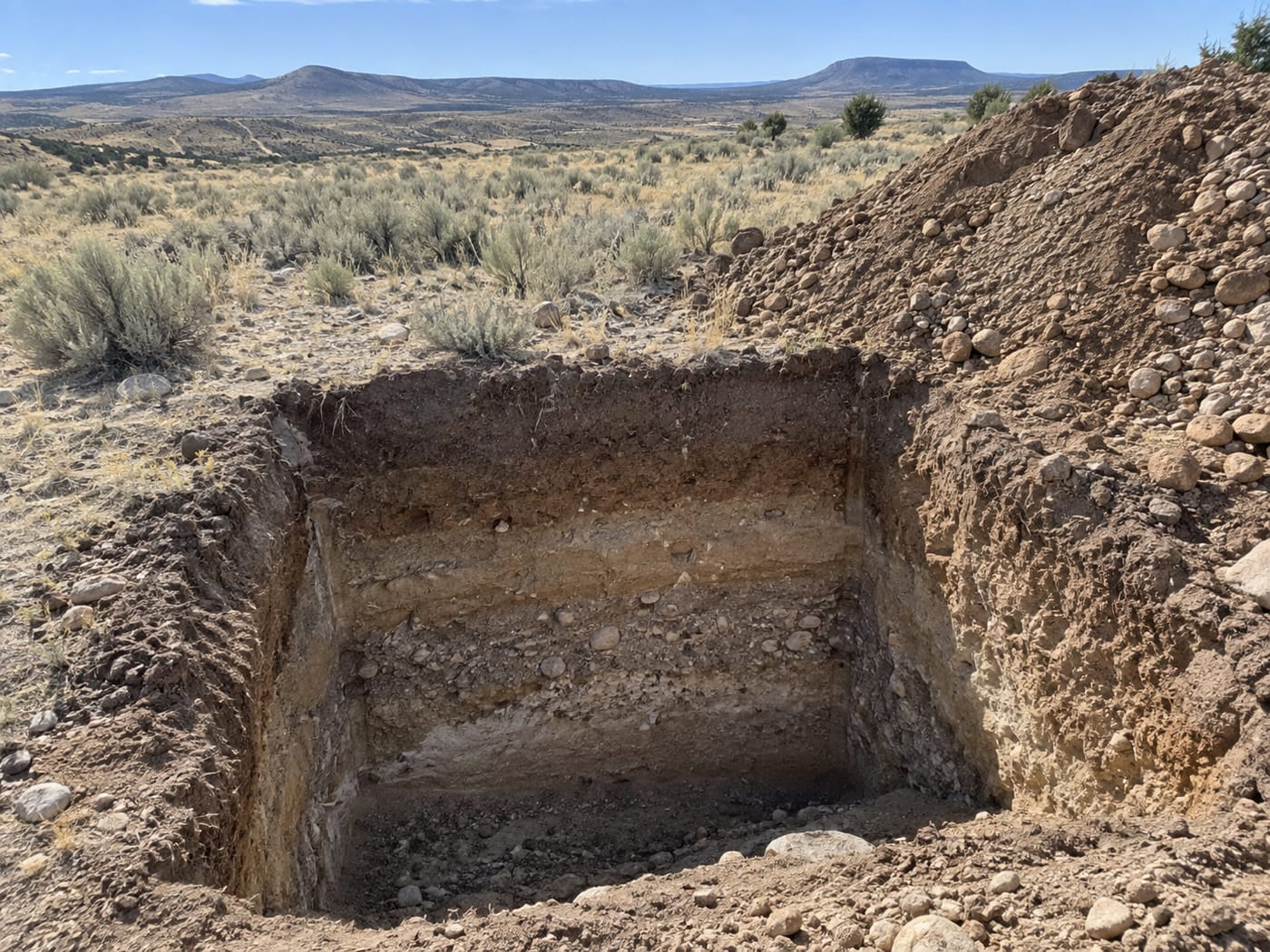
Before a septic permit can be issued, the district has to evaluate your site. That means test holes, dug where the drainfield would go, so a specialist can look at the actual soil profile.
You are responsible for the excavation. The applicant schedules a backhoe to dig the test holes at the time of the evaluation, and the health district does not provide machinery or labor. Test holes are required for all lots and parcels, not just ones that look questionable.
Plan for that as a real line item and a real scheduling exercise. You're coordinating an excavator and a health district specialist to be at the same place on the same morning.
What determines whether your site passes, and how big the system gets
Approval and sizing depend on a list of site-specific factors:
- Predicted maximum daily sewage flow
- House size and location on the parcel
- Well and spring locations, yours and neighboring ones
- Surface water locations
- Depth to groundwater or to limiting layers
- Changes to native soil, such as road cuts, grading, or benching
- Distance to neighboring structures, wells, buildings, and drainfields
- Soil type
- Proposed land use
The one that shapes your floor plan is bedroom count. Septic sizing is driven largely by predicted flow, and flow is estimated from bedrooms. The health district's own application asks for the number of bedrooms in the residence, and separately for any accessory dwelling unit.
That last detail matters more than it looks. If you're thinking about an ADU now or later, it is a septic question from the beginning. Idaho's new ADU law explicitly does not override laws regarding water, sewer, and utility services necessary to support the density. Zoning may say yes while your drainfield says no.
Systems designed to receive at least 2,500 gallons per day fall into a different category, a large soil absorption system, which requires a nutrient-pathogen evaluation with the application. That's generally beyond a single-family home, but worth knowing if you're planning something larger.
Septic permit mechanics
Permits and site evaluations are non-transferable between owners. If you buy a parcel with an existing evaluation from the prior owner, it doesn't come with the land.
They're time-limited. Septic permits are generally valid one year from issuance, and the cost of a site evaluation can typically be applied toward the full permit if ownership hasn't changed and the permit application comes within a year of the evaluation.
Installation has to be done by a licensed installer, registered with the state after passing the DEQ installer exam. Registrations come in basic and complex categories, with complex installers permitted to install alternative system types. If your site needs an alternative system, you need an installer licensed for it.
The system gets inspected by the health district after installation.
Buying a place that already has a system
Different question, and there's a records gap worth knowing about.
South Central Public Health District maintains a septic records portal covering its counties, searchable online. It's genuinely useful when you're evaluating a property.
But septic permits weren't required before 1971, so information may not exist for older systems. If you're looking at an older rural home, absence of a record isn't evidence of anything. It just means you're buying an unknown, and that's worth factoring into your offer and your inspection.
If you're planning to add bedrooms to an existing rural home, the existing system's capacity becomes the constraint. An addition that adds a bedroom is a septic question before it's a framing question.
Now the water side
Two separate things get confused constantly: the permit to drill, and the right to use the water.
The drilling permit. Under Idaho Code section 42-235, a drilling permit from the Idaho Department of Water Resources is required before drilling begins. Your driller usually handles this, and published fees run around $75 for domestic wells. Well drillers must be licensed under Idaho Code section 42-238, and wells are subject to inspection by IDWR and DEQ.
After the well is completed, the driller files a Well Driller's Report and a Notification of Seal with the department. Those reports are worth keeping, because they tell you what's actually down there.
The water right. This is the part with the exemption, and the part that just changed.
Idaho Code section 42-227 exempts wells drilled for domestic purposes from the water right permit requirement. Domestic purposes are defined in section 42-111 and include water for homes, livestock, and related uses, including irrigation of up to half an acre, with total use under 13,000 gallons per day.
So historically, a private domestic well on your own property didn't require a water right. Anything beyond that, irrigating more than half an acre for instance, required a separate water right and an approved right before a drilling permit for non-domestic use would issue.
What changed in 2025 and 2026
This is recent enough that plenty of people haven't caught up.
The 2025 Idaho Legislature passed Senate Bill 1083a, revising statutes dealing with domestic water use, shared wells, and subdivisions. Then on February 17, 2026, Governor Little signed Senate Bill 1222, which further revised the statutes on ground water wells and domestic uses, effective immediately on signing.
The upshot, as IDWR describes it: Idaho Code section 42-227 now provides that a permit is required for new domestic use, other than in-home uses, within subdivisions where a completed application to create the subdivision was filed with the county after July 1, 2025, in any area with restrictions on ground water development.
Unpacking that, three conditions have to line up for the restriction to apply. The parcel is in a subdivision, as statute defines it. The subdivision application was filed after July 1, 2025. And the area has restrictions on ground water development, meaning groundwater management areas, critical groundwater areas, or moratorium areas.
Why this matters locally. Parts of the Snake River Plain are subject to groundwater management restrictions, and the Magic Valley sits on it. So whether this applies to your parcel is a real question rather than a theoretical one, and the answer depends on your specific location and the history of the parcel.
What to actually do: ask IDWR directly about your parcel before you assume you can irrigate from a new well. The statute has been revised twice in under a year, IDWR has issued staff guidance on applying it, and this is not a good area to rely on what a neighbor did in 2019.
Wells and septic have to coexist
They're regulated by different agencies and they constrain each other.
Separation distances between a well and a drainfield are part of what the health district evaluates, along with distances to neighboring wells, buildings, and drainfields. On a small rural parcel with a house, a shop, a driveway, easements, and setbacks, the geometry gets tight faster than people expect.
This is why the site evaluation should come before design rather than after. The placement of the drainfield, the well, and the house are one problem, not three.
Test your water once the well is in. Published guidance for Idaho recommends analyzing samples at state-certified labs, with arsenic and nitrates among the common concerns. A well produces water. It doesn't guarantee the water is what you want coming out of a tap.
How this ties back to the building permit
The tracks converge at the county.
Twin Falls County's residential submittal requires a site plan showing well and septic locations, along with property lines, easements, setbacks, existing buildings, drainage, and the driveway. Two copies of the site plan need to be stamped approved by South Central Public Health District.
So your building permit is waiting on health district approval, which is waiting on a site evaluation, which is waiting on you getting a backhoe out to dig test holes. That chain is the single biggest reason rural projects start later than the owner expected.
Start it early. It costs almost nothing to book a site evaluation months before you're ready to build, and the answer shapes everything downstream.
Before you buy the land
If you're still shopping, ask these before you make an offer.
Has a septic site evaluation ever been done here, and what did it say? Remember it doesn't transfer, but knowing the prior result tells you a lot.
Is there an existing system, and is there a record of it? Check the health district's records portal, and remember nothing is recorded before 1971.
Is there a well, and is there a driller's report? That report tells you depth, yield, and what was encountered.
If there's no well, what are neighboring wells producing and at what depth? Driller's reports for the area are informative.
What are the groundwater restrictions for this area, and when was any subdivision application filed? This decides what you're allowed to use well water for.
How far is power, and what does it cost to bring it in? Not a health district question, but it belongs on the same list and it surprises people.
Building on acreage in the Magic Valley?
We build custom homes, shops, additions, ADUs, and barndominiums across Twin Falls, Jerome, Kimberly, Buhl, Filer, Burley, Rupert, and unincorporated Twin Falls County.
We'll walk your parcel, tell you what the site evaluation is likely to mean for your floor plan, and sequence the health district, the County, and the State so they don't collide. If the lot won't support what you're picturing, we'll tell you that before you pay for drawings.
We're a registered Idaho contractor, RCE-65510, insured and warrantied.
Tell us about your property → or call (208) 731-1729
I'm a builder, not an attorney or a water rights specialist. Water law in Idaho is complicated and it has changed twice recently, so confirm anything consequential with IDWR or a qualified professional.
Frequently asked questions
Who issues septic permits in Twin Falls County? South Central Public Health District, not the County building department. They administer Idaho's subsurface sewage disposal rules under an agreement with DEQ. Their Twin Falls office is at 1020 Washington Street North, (208) 734-5900.
What happens at a septic site evaluation? A specialist examines the soil profile through test holes dug where the drainfield would go. You are responsible for scheduling and paying for the excavation, since the health district does not provide machinery or labor. Test holes are required for all lots and parcels.
How many bedrooms can my septic support? That depends on soil, groundwater depth, available area, and separation distances, and it's determined by the site evaluation. Sizing is driven largely by predicted daily flow, which is estimated from bedroom count. This is why the evaluation should happen before the floor plan is finalized.
Does an ADU count against my septic? Yes. The health district's application asks separately for bedrooms in the residence and in an accessory dwelling unit. Idaho's ADU law explicitly does not override water and sewer requirements, so zoning permission doesn't mean your system can handle it.
Does a septic permit transfer when I buy the property? No. Septic permits and site evaluations are non-transferable between owners. Permits are also time-limited, generally one year.
Do I need a permit to drill a well? Yes. Under Idaho Code section 42-235, a drilling permit from IDWR is required before drilling, even for a domestic well, and the driller must be licensed. Published fees run around $75 for domestic wells.
Do I need a water right for a domestic well? Historically no, under the domestic exemption in Idaho Code section 42-227. That exemption covers in-home use, stock water, and irrigation of up to half an acre, with total use under 13,000 gallons per day. Anything beyond that requires a water right.
What changed with Idaho's well laws recently? Senate Bill 1083a in 2025 and Senate Bill 1222, signed February 17, 2026, revised the domestic exemption statutes. A permit is now required for new domestic use other than in-home uses within subdivisions where the subdivision application was filed with the county after July 1, 2025, in areas with restrictions on ground water development. Whether that applies to your parcel depends on location and timing, so ask IDWR.
Can I irrigate my lawn from my well? Up to half an acre under the traditional domestic exemption, subject to the changes above. More than that requires a separate water right. Given the recent statutory revisions, verify for your specific parcel rather than assuming.
Is there a record of the septic system on a property I'm buying? Maybe. South Central Public Health District has an online septic records portal covering its counties. But permits weren't required before 1971, so older systems may have no record at all.
How early should I start this process? Earlier than feels necessary. Your county building permit submittal requires a site plan stamped by the health district, which requires a site evaluation, which requires you to arrange excavation. That chain is the most common reason rural projects start late.
Sources: IDAPA 58.01.03, Individual and Subsurface Sewage Disposal Rules; Idaho Department of Environmental Quality septic guidance; South Central Public Health District published application materials and septic records information; Idaho Code sections 42-111, 42-227, 42-235, and 42-238; Idaho Department of Water Resources domestic exemption guidance, reflecting Senate Bill 1083a (2025) and Senate Bill 1222 (2026); Twin Falls County Building Department submittal requirements. Verified September 2026. Water law has changed twice recently and health district requirements are site-specific, so confirm with the agencies for your parcel.