TL;DR
- Yes, and it happens all the time. Cold weather concreting is a defined procedure, not a gamble. It's also more expensive, and done carelessly it ruins the pour permanently.
- 500 psi is the number that matters. Concrete protected from freezing until it reaches at least 500 psi compressive strength won't be damaged by a freeze. Below that, a hard freeze can wreck it for good.
- Fresh concrete freezes around 27°F, not 32°F. Protection is about overnight lows during the protection period, not just the forecast high.
- Cold weather rules kick in around 40°F. Hydration slows dramatically below that and essentially stops at freezing.
- Never pour on frozen ground. Frozen subgrade pulls heat out of the bottom of the slab and then heaves and settles as it thaws, cracking the slab no matter how well you protected the top.
- Minimum placement temperature depends on section thickness. Thin sections need to start warmer because they lose heat faster.
- Pulling the blankets too early is the classic mistake, and it can cost 20 to 50 percent of the concrete's potential strength.
- Twin Falls County has a severe weathering rating and a zero degree design temperature. This isn't a marginal cold climate.
Somebody always asks this in October, usually because the schedule slipped and the choice is now between pouring in the cold or waiting until spring.
The short answer is yes. Concrete gets poured through Idaho winters routinely and performs perfectly for decades. The longer answer is that it only works if the crew follows a specific procedure, and the failure mode isn't obvious for years, which is exactly why some crews skip steps.
Here's what's actually involved, so you can tell the difference.
What "cold weather" means technically
It isn't a feeling. The industry standard, ACI 306, triggers cold weather concreting requirements when the average daily air temperature falls below 40°F for three consecutive days, and practically speaking, whenever air temperature is below 40°F or expected to drop below 40°F within 24 hours of placement.
Forty degrees matters because that's roughly where cement hydration, the chemical reaction that turns a wet mix into hard concrete, slows dramatically. At freezing it stops almost entirely.
The consequence is slower strength gain, and it's not a small effect. Concrete cured at 40°F reaches only about half the 28-day strength of the same concrete cured at 70°F, unless it's protected. Below 40°F without protection, it may never reach the strength it was designed for.
The one number to remember: 500 psi
This is the whole game.
Concrete protected from freezing until it attains a compressive strength of at least 500 psi will not be damaged by exposure to a single freezing and thawing cycle. It will go on to reach its potential strength and won't be harmed by later cold weather.
Below 500 psi, a hard freeze can cause irreversible damage, including significant loss of strength and durability.
Why 500 psi specifically? By that point, enough of the mix water has been consumed by hydration that the remaining water can't do freeze damage. Before that, there's still free water sitting in the paste.
What freezing actually does. Water expands about 9 percent when it turns to ice. Inside fresh concrete, that expansion tears apart the crystal structure that's still forming, leaving permanent microcracks. The concrete may look fine. It isn't.
One detail most people get wrong: fresh concrete freezes at approximately 27°F, not 32°F. The dissolved material in the mix depresses the freezing point. That's a small margin of comfort, not a large one, and it means protection decisions should be based on overnight lows during the protection period.
How long to 500 psi? Roughly 48 hours at 40°F, and about 24 hours at 50°F, with ordinary cement. Below 40°F with no protection, possibly never.
Never pour on frozen ground
If you take one practical thing from this, take this one, because it's the failure that no amount of blanket coverage can fix.
The surface the concrete is placed on has to be above freezing. Pouring onto frozen ground pulls heat out of the bottom of the slab and can freeze it from below while the top looks fine.
Worse, frozen subgrade heaves while it's frozen and then settles as it thaws. That movement cracks the slab regardless of how carefully the top was protected. You protected the concrete and the ground beneath it moved anyway.
Thawing the subbase before the truck arrives, typically 12 to 18 inches deep using ground heaters or hydronic blankets, is a real line item and a real amount of time. A crew that skips it is saving money at your expense.
This matters more here than in warmer parts of the country. Twin Falls County designs to a frost line of 24 inches below finished grade, which tells you how deep the ground actually freezes.
Minimum placement temperature depends on thickness
Concrete has to arrive warm enough, and how warm depends on how thick the section is. Thin sections lose heat to the environment much faster, so they need to start hotter.
Section thickness | Minimum as-placed temperature |
|---|---|
Under 12 inches | 55°F |
12 to 36 inches | 50°F |
36 to 72 inches | 45°F |
Over 72 inches | 40°F |
Most residential work, slabs, footings, and foundation walls, sits in the top two rows. That's a discharge temperature you specify when you order from the ready-mix plant, not something you hope for.
There's a ceiling too. Placement temperature generally shouldn't exceed about 80°F even when materials are heated, because overheated concrete brings its own problems.
How it's actually done
The methods are well established, and a competent crew will be using several at once.
Heated mix water, heated aggregates, or both. This is the most effective way to get the concrete to the required temperature. Plants can heat mix water substantially, within limits that avoid flash set.
Accelerating admixtures. These speed up early strength gain so the concrete reaches 500 psi sooner. A note worth knowing: calcium chloride accelerates well but carries corrosion risk with reinforcing steel, so non-chloride accelerators are generally the right call in reinforced work. If you have rebar in it, ask which is being used.
Type III cement. Higher early strength, often paired with a non-chloride accelerator for severely cold conditions.
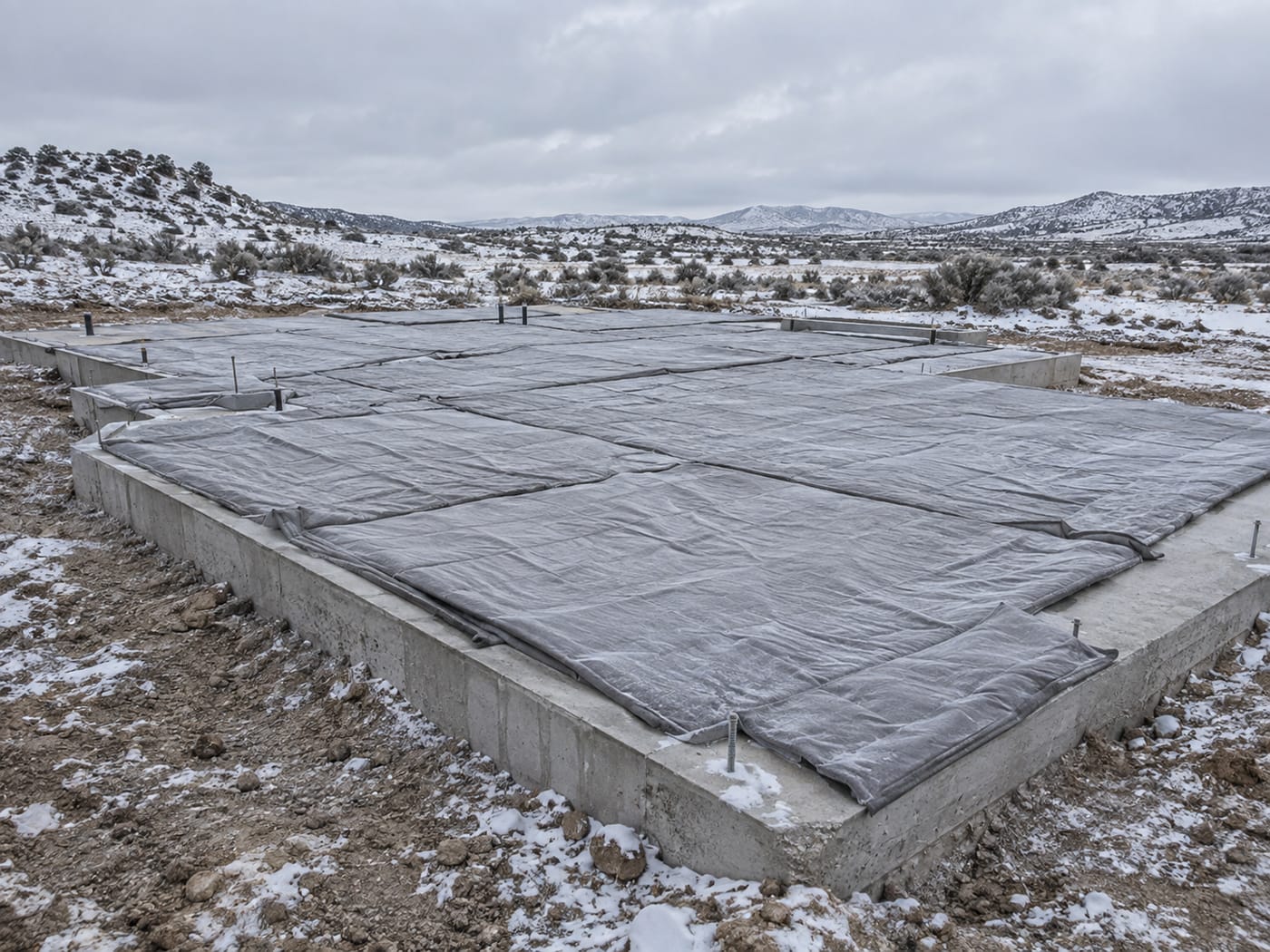
Insulated curing blankets. The workhorse. They hold in the concrete's own hydration heat, which is what actually gets it to strength.
Heated enclosures and heated forms. For more severe conditions or critical pours.
Air entrainment. Deliberately introducing microscopic air bubbles gives freezing water somewhere to expand into, which is what makes hardened concrete durable through freeze and thaw cycles. This matters in Twin Falls County, where the published weathering probability for concrete is rated severe.
In-place temperature monitoring. Sensors that tell you what the concrete is actually doing rather than what the air temperature suggests. This is how you know when it's safe to pull protection instead of guessing.
The mistake that ruins otherwise good work
Pulling the blankets too early.
It's one of the most common and most expensive cold weather errors. If protection comes off before the concrete has reached strength, or comes off so abruptly that a warm surface hits cold air, you lose strength that never comes back. In bad cases that's 20 to 50 percent.
The thermal shock part is what surprises people. Even concrete that's reached strength can crack if you expose a warm surface to sharply colder air. Protection is supposed to come off gradually, and heating during the protection period is generally limited to around 10°F per hour for the same reason.
So when a crew pours on Friday and strips everything Monday morning because the weather looks fine, that's not necessarily fine. The question is what the concrete's internal temperature has been doing, and whether anyone measured it.
Why this matters more in the Magic Valley
Twin Falls County publishes its design criteria, and two of them are directly relevant here.
The design temperature is 0°F. That's the number structures are designed against. This is not a marginal cold climate where a bad night is 35 degrees.
The weathering probability for concrete is rated severe. That's the highest category, and it's why air entrainment and proper mix design matter for anything exposed, including driveways, flatwork, and foundation walls.
Add the 24 inch frost line and you have a place where winter concrete work is entirely routine and entirely unforgiving of shortcuts.
Should you pour, or wait?
Honest version: it depends on what you're pouring and what waiting costs you.
Reasons to go ahead. The procedure is well understood and works. Getting a foundation in before spring means framing can start when the weather breaks rather than waiting on excavation. And there's a scheduling reality worth knowing: building permits in Twin Falls County expire 180 days from issuance or from the date of your last inspection, so a project that sits idle all winter can quietly lapse.
Reasons to wait. Cold weather concreting costs more, sometimes considerably, between heated materials, admixtures, blankets, enclosures, ground thawing, and the extra days of protection. If your project has no urgency, spending that money to gain six weeks may not be worth it. And if a crew is being pressured to pour in conditions they're not equipped for, waiting is obviously better than a compromised foundation.
The thing I'd actually weigh. Not the temperature on pour day. Whether the people doing it have the equipment and the schedule room to protect it properly for the full protection period. A pour is a few hours. Protection is days.
What to ask before a winter pour
What's the specified discharge temperature? They should have a number, and it should match the section thickness.
How is the subgrade being thawed, and how deep? If the answer is that it doesn't need thawing, ask why.
What admixture is being used, and is it chloride-based? Especially if there's rebar.
How long will protection stay on, and how will you know when it's safe to remove? Listen for in-place monitoring rather than a calendar.
What's the plan if the forecast changes? Cold snaps arrive early here, and the answer shouldn't be improvised.
Is the mix air-entrained? For anything exposed to weather in a severe weathering region, it should be.
A builder who pours through winters routinely will answer all six without pausing. One who's guessing will get vague around the protection period, which is exactly where the money and the risk are.
Planning a winter build?
We build custom homes, shops, additions, ADUs, and barndominiums across Twin Falls, Jerome, Kimberly, Buhl, Filer, Burley, Rupert, and unincorporated Twin Falls County.
We'll tell you honestly whether pouring now makes sense for your project or whether waiting serves you better, and if we pour, we'll tell you exactly how the concrete is being protected and for how long.
We're a registered Idaho contractor, RCE-65510, insured and warrantied.
Tell us about your project → or call (208) 731-1729
Frequently asked questions
Can concrete be poured in freezing weather? Yes, with proper procedure. Cold weather concreting is a well-defined practice involving heated materials, admixtures, insulation, and a protection period. Thousands of residential pours happen in freezing conditions every year and perform for decades. The ones that fail are the ones where steps were skipped.
At what temperature is it too cold to pour? There isn't a hard cutoff, because it depends on protection rather than air temperature. Cold weather requirements generally apply below 40°F. What matters is keeping the concrete above its minimum temperature until it reaches 500 psi.
What is the 500 psi rule? Concrete protected from freezing until it reaches at least 500 psi compressive strength won't be damaged by a freeze and will go on to reach its designed strength. Below 500 psi, freezing can cause permanent damage and significant strength loss.
How long does it take to reach 500 psi in cold weather? Roughly 48 hours at 40°F and about 24 hours at 50°F with ordinary cement. Below 40°F without protection, it may never get there. Accelerators and Type III cement shorten the window.
Does concrete freeze at 32 degrees? Fresh concrete freezes at approximately 27°F, not 32°F, because dissolved material in the mix lowers the freezing point. That's a narrow margin, so protection decisions should be based on forecast overnight lows during the protection period.
Can you pour on frozen ground? No. Frozen subgrade pulls heat out of the bottom of the pour and then heaves and settles as it thaws, cracking the slab regardless of how well the top was protected. The subbase has to be thawed first, typically 12 to 18 inches deep.
What does cold weather concreting cost extra? It varies by project, but you're paying for heated materials, admixtures, insulated blankets or enclosures, subgrade thawing, and additional days of protection and monitoring. Ask for it as a line item so you can weigh it against waiting.
What happens if concrete freezes before it cures? Water expands about 9 percent as it becomes ice, which tears apart the forming crystal structure and leaves permanent microcracks. The damage can mean strength losses of up to roughly 50 percent, and it usually isn't visible on the surface.
When can the blankets come off? When the concrete has reached strength, verified rather than assumed, and gradually enough to avoid thermal shock. Pulling protection too early, or exposing a warm surface to sharply colder air, is one of the most common and most costly cold weather mistakes.
Should I just wait until spring? Sometimes. If there's no schedule pressure, waiting avoids the added cost. But note that county building permits expire 180 days from issuance or your last inspection, so an idle winter can cost you the permit. Weigh the extra cost against the schedule you actually need.
Sources: American Concrete Institute ACI 306R-16, Guide to Cold Weather Concreting, and published industry guidance on cold weather concrete practice, accessed September 2026; Twin Falls County Building Department published design criteria. Verified September 2026. Mix design and protection requirements are project-specific, so rely on your engineer and ready-mix supplier for your actual pour.