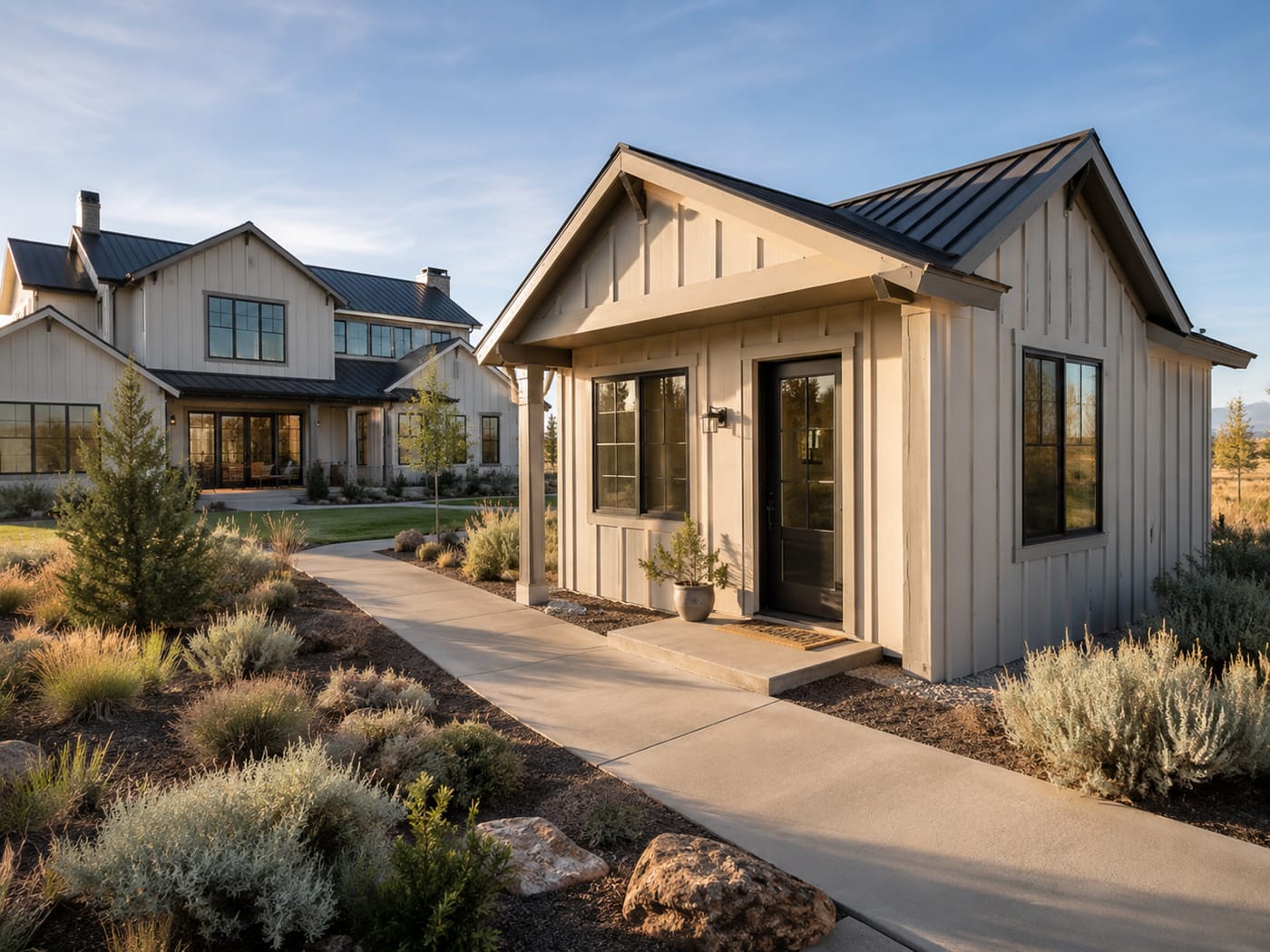
TL;DR
- The question isn't ADU versus addition. It's how much separation the situation needs, now and in five years.
- An ADU is a second self-contained dwelling. Own kitchen, own bathroom, own entry. Best when independence matters and the relationship works better with a door between.
- An addition shares the house's systems. Usually less expensive per square foot, and better when care is already hands-on or heading that way.
- In the Magic Valley, septic capacity stops more of these projects than zoning does. A second full dwelling adds wastewater load, and that's a health district question no law overrides.
- SB 1354 helps only in Twin Falls, Jerome, and Burley. Everywhere else in our area, including Kimberly, Buhl, and Filer, and all of unincorporated Twin Falls County, the old rules apply.
- Build for the care level you'll need later, not the one you have now. Zero-step entry, 36 inch doors, and blocking in the bathroom walls cost almost nothing during construction and are expensive to retrofit.
- Assisted living in Twin Falls runs somewhere between roughly $3,800 and $5,300 a month depending on which survey you believe. That's the number worth putting against a construction budget.
- Adding a dwelling raises your assessed value, and Idaho's homeowner's exemption is capped, so most of the new value is taxable.
This is one of the more common conversations I have, and one of the harder ones, because it's never really a construction question. It's a family question wearing construction clothes.
Someone's parent is still independent but the stairs at their place have become a problem. Or there's been a fall. Or a spouse died and nobody wants to say out loud that the house they've lived in for forty years isn't working anymore.
So here's how I'd think through it, including the parts that don't show up on a floor plan.
Start with the question that actually decides it
Not cost. Not zoning. This one:
How much separation does this arrangement need, and how much will it need in five years?
Those are two different answers, and the second one is the one people skip.
A parent who drives, cooks, and wants their own space is a different project than a parent who needs someone within earshot at night. And the first frequently becomes the second, often faster than anyone expected.
If you build for today's independence and the situation changes, you're either renovating again or moving them anyway. If you build for maximum care and it never gets there, you've spent money on something nobody needed and made everyone feel watched.
The honest middle is usually this: build the separation they want now, with the bones to support more care later. That's mostly about dimensions and blocking, and it's cheap while the walls are open.
ADU or addition: what actually differs
Detached or internal ADU | Addition | |
|---|---|---|
Kitchen | Full, its own | Usually shares the main kitchen, sometimes a kitchenette |
Entry | Separate | Often both a separate entry and an interior connection |
Cost per square foot | Higher, it's a second full dwelling | Lower, shares systems with the house |
Utilities and mechanicals | Second set, or a substantial extension | Usually extends the existing system |
Independence | High | Moderate, by design |
Supervision and response time | Lower | Higher |
Rentable later | Yes | Generally no |
Resale flexibility | Broad, appeals to multiple buyer types | Adds square footage to the main house |
Zoning exposure | Governed by ADU rules, which vary by city | Treated as a normal addition |
Septic load | Adds a dwelling unit | Adds bedrooms and fixtures, usually less impact |
The line that matters most on that table is cost per square foot, and the reason is simple. An ADU carries a second of nearly everything: kitchen, bathroom, heating, water heater, electrical service, and often its own connections. An addition borrows from what's already there.
So when someone tells me they want an ADU because it'll be cheaper than adding on, I know we haven't priced it yet.
Where the ADU wins is when independence is the actual goal. A parent who has run their own household for fifty years and is not interested in living in their child's spare room. A separate front door is not a small thing psychologically. It's often the whole point.
Where the addition wins is when care is already hands-on, or when the budget is tight, or when the lot can't take a second structure. A suite off the back of the house with its own entrance, a full bath, and a door that closes gives most of the privacy at a fraction of the second-kitchen cost.
Can you legally build an ADU where you live?
Idaho's new ADU law changed a lot this summer, but it's narrower than the coverage suggests.
SB 1354 took effect July 1, 2026, and it bars cities from banning ADUs in residential zones. It applies only to cities with populations over 10,000. In our service area that means Twin Falls, Jerome, and Burley. It does not cover Kimberly, Buhl, Filer, Rupert, or any smaller town, and it does not apply to counties at all, so unincorporated Twin Falls County is untouched.
Where it does apply, the practical effects are significant: cities must allow either one internal or one detached ADU per lot, cannot require owner-occupancy, cannot cap size below 1,000 square feet or 75 percent of the primary dwelling, and must approve qualifying projects administratively without a hearing. Cities have until February 1, 2027 to update their codes.
Outside those three cities, an ADU may still be allowed. It's just not a protected right, and your city or the county sets the terms. Additions, meanwhile, are governed by normal zoning everywhere, which is one reason they're sometimes the path of least resistance.
I wrote a full breakdown of the ADU law separately if you want the details.
The thing that actually stops these projects
Septic.
I want to put this early because I've watched families get through design and budget before anyone asked, and it's a demoralizing place to discover a problem.
A second self-contained dwelling with its own kitchen and bathroom adds wastewater load. A drainfield sized for a three bedroom house does not automatically absorb an ADU. In unincorporated Twin Falls County that's a South Central Public Health District question, and SB 1354 explicitly does not override laws regarding water, sewer, and utility services needed to support the density.
An addition can trigger this too, particularly if it adds bedrooms, since septic sizing is generally driven by bedroom count.
Ask this question first. Before design, before budget, before you've told your mother it's happening. If you're on a well, ask about capacity at the same time.
Build for the care level you don't need yet
This is the part I care most about, because it costs almost nothing during construction and a fortune afterward.
Single-family homes aren't required to meet accessibility standards. That means nobody will make you do any of this. It also means most builders won't bring it up.
Worth doing in almost every case:
- Zero-step entry. At least one entrance with no step at all, not one step. Grade the walk, or design the slab. This is the single highest-value decision on the list, and it's nearly impossible to add later without it looking added later.
- 36 inch doors throughout the unit, including the bathroom. A standard 32 inch door does not pass a wheelchair or a walker comfortably.
- Blocking in the bathroom walls. Solid backing behind the drywall around the toilet, the tub, and the shower. Grab bars can then be installed anywhere, anytime, in an afternoon. Without blocking it's a demolition project.
- A curbless shower, or at minimum a low-threshold one, with the drain and slope planned before the slab or the framing.
- Lever handles and rocker switches instead of knobs and toggles. Arthritis makes round knobs genuinely difficult.
- Everything on one level, including laundry.
- Wider hallways, 42 inches where you can get it.
- Better lighting than you think you need, especially at stairs, thresholds, and the bathroom at night. Aging eyes need substantially more light and struggle more with glare and contrast.
Worth thinking about, depending on the situation:
- A bathroom big enough to turn a wheelchair, roughly a five foot circle of clear floor
- A bedroom that can fit a hospital bed with access on both sides
- A path from the parking area to the door that stays clear in an Idaho winter
- Space for a caregiver to sit, or sleep, if it ever comes to that
- Sound separation, which cuts both ways, since they hear your household and you hear theirs
None of that has to look institutional. Most of it is invisible when it's done right. A curbless shower reads as modern, not medical.
What about the money?
Two numbers matter, and the second one is the one families skip.
What it costs to build. That depends on size, finishes, site conditions, and whether you're extending systems or duplicating them. I'm not going to publish a price per square foot here, because that number is misleading even when it's accurate.
What the alternative costs. This is the comparison that actually clarifies things. Published figures for assisted living in Twin Falls vary quite a bit by source, running from roughly $3,800 to $5,300 a month, with memory care generally higher. Statewide home care rates have been surveyed around $34 an hour.
Those numbers disagree because different surveys measure different things, so treat them as a range rather than a quote. But even at the low end, that's on the order of $46,000 a year, ongoing, indefinitely.
Put a construction budget next to that and the math looks different than it does in isolation. A build is a one-time cost that leaves you with an asset. Care is a recurring cost that doesn't.
I want to be careful here, though, because that comparison can be misleading in the other direction. Building a space does not provide care. If your parent needs medical supervision, a well-designed ADU doesn't replace assisted living. It replaces their old house. The honest comparison is between them living independently somewhere else and living independently at your place, not between construction and skilled nursing.
Two financial wrinkles specific to Idaho.
Adding a dwelling raises your assessed value. Idaho's homeowner's exemption removes 50 percent of the value of your primary residence and up to one acre, capped at $125,000. If you're already at that cap, and many homeowners are, the assessed value of a new ADU is largely taxable. And an ADU that's rented rather than occupied by family is treated differently again. Ask the Twin Falls County Assessor how they'd handle your specific situation before you assume.
Second, if your parent is selling their own home to fund this, there are tax, benefits, and eligibility consequences well outside my lane. Talk to an accountant and, if long-term care assistance might ever be in the picture, an elder law attorney. Get that advice before money moves, not after.
The part nobody puts in a blog post
I'll say it anyway, because pretending otherwise doesn't help anybody.
These arrangements work when everyone involved has genuinely agreed to them, and they go badly when one person decided and everyone else accommodated. The construction is the easy part.
Some questions worth asking out loud before you build:
- Does your parent actually want this, or are they agreeing because they think they should?
- Who's providing care, realistically, and does that person know?
- What happens if care needs exceed what your family can provide?
- How does this land with siblings, including the ones who aren't nearby?
- What happens to this space, and this arrangement, if things change?
I've built these for families where it was clearly the right call and everyone was relieved. I've also had conversations where it became clear during the walkthrough that the family hadn't actually talked about it yet. When that happens, I'd rather slow down than sell a project.
So which one should you build?
Build the ADU if independence is the point, your lot and septic can support it, you're in a jurisdiction that allows it, and you want a space that has a life after this chapter, as a rental, a guest house, or a selling feature.
Build the addition if care is already hands-on or clearly heading that way, the budget is tighter, the lot can't take a second structure, septic won't support a second unit, or you want the space to fold back into the main house later.
Consider neither if what your parent actually needs is medical care rather than housing, or if the family hasn't reached real agreement, or if the lot investigation says no. I'd rather tell you that early than halfway through.
Thinking through a space for a parent?
We build ADUs, guest homes, and additions across Twin Falls, Jerome, Kimberly, Buhl, Filer, Burley, Rupert, and unincorporated Twin Falls County. We'll look at your lot, tell you what your septic can realistically support, walk you through whether an ADU is even permitted at your address, and design for the care level you might need later rather than only the one you need now.
We're a registered Idaho contractor, RCE-65510, insured and warrantied. One point of contact, an itemized estimate you can read line by line, and an honest answer even when the answer is that a different approach would serve your family better.
Tell us about your situation → or call (208) 731-1729
I'm a builder, not an attorney, accountant, or care professional. For tax, benefits, and long-term care questions, talk to people who do that work.
Frequently asked questions
Is an ADU cheaper than an addition? Usually not, per square foot. An ADU is a second self-contained dwelling with its own kitchen, bathroom, heating, and service connections. An addition extends what the house already has. ADUs win on independence and future flexibility, not on price.
Can I build an ADU for my mom on my lot? It depends on your address. Since July 1, 2026, Idaho cities over 10,000 population cannot ban ADUs in residential zones, which locally covers Twin Falls, Jerome, and Burley. Kimberly, Buhl, Filer, Rupert, smaller towns, and unincorporated Twin Falls County are not covered, so local rules govern. Zoning is only half the question, though. Septic capacity is often the real limit.
Will my septic system handle it? Not automatically. A second dwelling with its own kitchen and bathroom adds wastewater load, and septic sizing is generally driven by bedroom count. In unincorporated Twin Falls County this goes through South Central Public Health District. Ask before you design, because it is the most common reason these projects stop.
Does the new ADU law mean I don't need permits? No. SB 1354 addresses zoning, not building code. Your ADU is a dwelling and needs a building permit, egress, ceiling height, alarms, energy compliance, and inspections like any habitable space. Which office issues the permit depends on whether you're inside city limits.
What accessibility features should I include? At minimum, a zero-step entry, 36 inch doors, solid blocking in the bathroom walls for future grab bars, a curbless or low-threshold shower, lever handles, and everything on one level. Single-family homes aren't required to meet accessibility standards, so nobody will require this. It's inexpensive during construction and costly to retrofit.
Can I rent the unit out later? An ADU, generally yes, and in covered cities owner-occupancy requirements are no longer permitted. An addition, generally no, since it's part of your house. If rental income is part of the long-term plan, that argues for the ADU. Check short-term rental rules separately, as those are governed by different law.
How does this affect my property taxes? Adding a dwelling increases assessed value. Idaho's homeowner's exemption covers 50 percent of your primary residence's value plus up to one acre, capped at $125,000, and many homeowners are already at that cap. An ADU used as a rental is treated differently from one occupied by family. Ask the Twin Falls County Assessor about your specific plan.
Should my parent sell their house to pay for this? That's a question for an accountant, and if long-term care assistance could ever be relevant, an elder law attorney too. There are tax and eligibility consequences that are easy to trigger accidentally and hard to undo.
Is it cheaper than assisted living? Published assisted living costs in Twin Falls range from roughly $3,800 to $5,300 a month depending on the survey, so annually that's substantial and ongoing. A build is one-time and leaves you with an asset. But building space is not the same as providing care. If medical supervision is needed, the comparison isn't valid.
How long does it take? Design, permitting, and construction, with the permitting piece varying by jurisdiction. Get the septic question answered first, because that's the step most likely to change the whole plan, and it costs nothing to ask early.
Sources: Idaho Code 67-6541 (SB 1354, 2026); Idaho Code 63-602G and Idaho State Tax Commission guidance on the homeowner's exemption; published cost of care surveys for Twin Falls and Idaho, which vary meaningfully by source. Verified August 2026. Costs, tax rules, and local ordinances change, so confirm current figures with the relevant agency.
Related: Idaho's New ADU Law · Building Permits in Twin Falls · ADUs & Guest Homes · Home Additions